Three at Dawn or Four at Musk
<Original Version, Translated>
During the Warring States Era, there lived a man who loved taking care of his monkeys (as pets).
He felt incredibly thankful to have such animals that understand his intentions, so much so that he would take from food reserved for his family and feed the monkeies.
However, this couldn't last long. His family was running out of food, and so he decided to reduce the number of acorns to provide for his monkeys.
One night, this man proposed that he give them three nuts in the morning and four nuts at night. The moment they heard that they will get less food in a day, the monkeys began gritting their teeth in anger.
The man then changed his proposal: the monkeys would receive four nuts in the morning and three nuts at night. Monkeys were happy with the new proposal and agreed to the man's term.
This is a popular Chinese fable that emphasizes "stupidity of greed" and "naivety" to raise childrens' awareness about "deceit" and "unthoughtful decision". At least, that was how many kids and the young-"I" learned this story.
BUT
The takeaway dramatically changes the moment the concept of "Time Value of Money" comes into play.
All we need for this change is two modifications:
-
Extend gap between two payments from "day" to "year"
i.e., "beginning of the year" and "end of the year" -
Change payment medium from "nuts" to "dollars"
i.e., "Million Dollars"
To sound more "finance", let's call the man "debtor" (someone who needs to pay) and monkeys "creditor" (someone who is entitled to the payment). After making these modifications, the story takes a completely different nuisance.
<Modified Version>
On January 1, 2020, debtor A proposed that he pays three million dollars today and pay four million dollars at the end of this year to the creditor, B.
After creditor B expressed his discontent, debtor A makes a new proposal where he pays four million dollars today and pay three million dollars at the end of the year.
Creditor B was happy about the new terms.
After negotiation, creditor B receives 1 million dollars in advance compared to Proposal 1. This 1 million dollar provides a massive edge.
Assuming bank pays interest over the year, the final payout for creditor B will vary. Refer to the grahpic below.
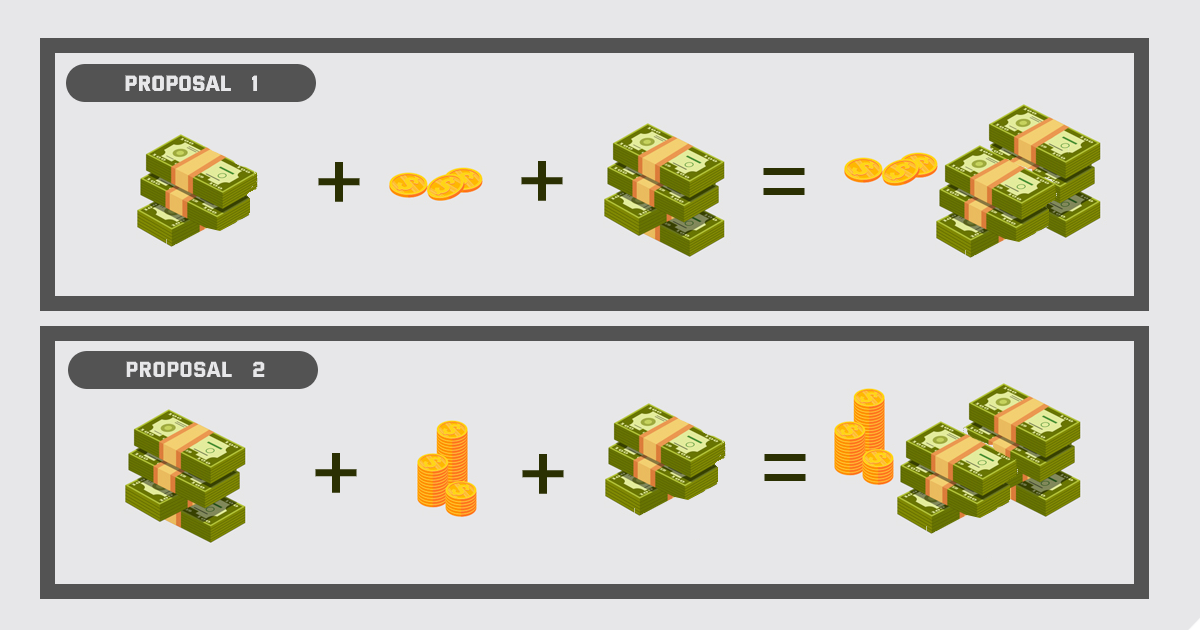
At the end of the period, in both proposals, the creditor B receives $7million in total. However, assuming B deposits his money in bank or makes any interest-bearing investment, he gains opportunity to earn extra income from that extra $1million received in advance (as represented by the difference in number of gold coins in the image).
Assuming 2% interest rate, the difference wil be:
Proposal 1.
$$
\$3million \times 2\% = \$60,000
$$
Proposal 2.
$$
\$4million \times 2\% = \$80,000
$$
Difference
$$
\$20,000
$$
By the end of the year, Proposal 2 yields at least $1million $\times$ the interest rate than Proposal 1.
At least within this context, monkeys weren't stupid after all.
As we expand our knowledge and understanding relating to "value", the understanding that "value changes over time" is crucial. In the following episodes, we will dive deeper into how time value of money is calculated and utilized in the real life settings.
'Study Note > Quantitative Methods' 카테고리의 다른 글
| 【Calculus & Algebra】Limits & Derivatives (0) | 2020.07.13 |
|---|
