The Fitted Line
Basic Idea
In practice, we only see the observations plotted in Fig 5.

In order to derive the shape of the line that might have generated these points, we can use $P_1$-$P_4$ points to draw a line which is an approximation to the $Y = \beta_1+\beta_{2}X + u$.
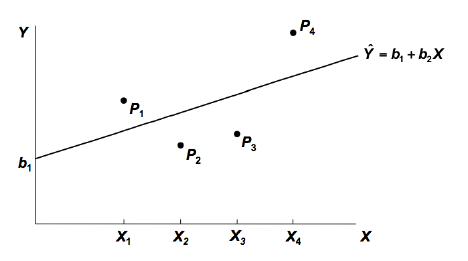
We write this line as $\hat{Y} = b_1+b_{2}X$, where the hat ("^") represents the fitted variable, lower case $b$'s represent estimate of parameters $\beta$. This line is called "the fitted model" and the values of $Y$ predicted by the model are called the fitted values of Y ($\hat{Y}$).
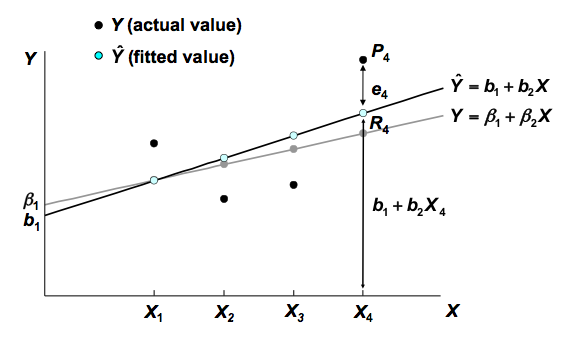
The discrepancies between the actual and fitted values of $Y$ are known as the residuals (the difference between real and estimated value). The notation commonly used for residuals is either $\hat{u}$ or $e$.
If the fit is a good one, the residuals and the values of the disturbance term will be similar, but they must be kept apart conceptually. To illustrate this point, the figures below illustrate two ways through which the values of $Y$ can be decomposed.

*Ex-Ante: the prediction of a particular event in the future.
Using theoretical relationship, $Y$ can be decomposed into its nonstochastic (nonrandom) component $\beta_1 + \beta_{2}X$ and its random component $u$. This is a theoretical decomposition because we do not know the true values of $\beta_1$ or $\beta_2$, or the values of the disturbance term $u$. But on a theoretical note, we shall use it in our analysis of the properties of the regression coefficients.
*Ex-Ante: after the event.
The other decomposition is with reference to the fitted line. In each observation, the actual value of $Y$ is eqqual to the fitted value plus the residual (as versus $\beta$s plus the disturbance term). This is an operational decomposition which we will (and can) use for practical purposes.
To be continued.
'Study Note > Econometrics' 카테고리의 다른 글
| 【Econometrics】Ordinary Least Square (OLS) (0) | 2020.07.16 |
|---|---|
| 【Econometrics】The Fitted Line : Estimation of Beta (0) | 2020.07.10 |
| 【Econometrics】Data Generating Process (0) | 2020.07.10 |
| 【Econometrics】Proof of Properties of Estimator (0) | 2020.06.27 |
| 【Econometrics】Estimator (0) | 2020.06.27 |
| 【Econometrics】Derivatives (0) | 2020.06.17 |
| 【Econometrics】Data Types (0) | 2020.06.17 |
| 【Econometrics】Econometric Questions (0) | 2020.06.17 |